首页 / golang
go design (二) slice
golang 中如何去设计变长数组
我们在 谈论 slice 的时候到底在 讲什么?
go中 关于slice的结构定义
// src/runtime/slice.go
type slice struct {
	array unsafe.Pointer // 元素指针
	len   int			 // 数据的长度
	cap   int			 // 数据的容量
}-
指针指向元素数组的地址 、
len为实际数据的长度、cap为底层数组的长度 -
所以 默认
cap >= len -
底层数组是可以被多个
slice同时指向的,因此对一个slice的元素进行操作是有可能影响到其他slice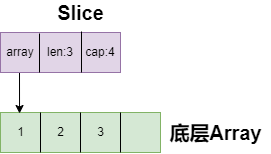

slice 的创建
-
在谈具体的 创建之前 必须要理解
nil slice与empty slice两种情况nil sliceempty slice的len与cap都是0- 但
empty slice其指针地址为0xc42003bda0所有的empty slice共享这个地址 - 而
nil slice默认是没有 指针地址 等同于nil - 所以官方默认推荐 为
nil slice
-
直接声明
var s1 []int // nil slice var s2 = []int{} // empty slice fmt.Println(s1 == nil) // true fmt.Println(s2 == nil) // false marshal1, _ := json.Marshal(s1) marshal2, _ := json.Marshal(s2) fmt.Println(string(marshal1)) // null 注意 json 格式化时候的坑 fmt.Println(string(marshal2)) // [] -
字面量
s1 := []int{0, 1, 2, 5: 100} fmt.Println(s1, len(s1), cap(s1)) // [0 1 2 0 0 100] 6 6- 特性 字面量支持 使用索引号,直接赋值
-
new
slice := new([]int) // nil slice fmt.Println(cap(*slice), len(*slice), *slice == nil)// 0 0 truenew返回的是对slice的引用 , 解引用之后的值为nil slice
-
make
make函数需要传入三个参数:切片类型,长度,容量[选填,默认等于长度]
s := make([]int, 0) // empty slice fmt.Println(s == nil) // falsemake会返回一个有初始值的类型, 所以 当len = 0时make出来的实际上是 一个empty slice
-
从切片或数组截取
   	slice := []int{0, 1, 2, 3, 4, 5, 6, 7, 8, 9}
   	s1 := slice[2:5]
   	fmt.Println(s1, cap(s1), len(s1)) // 2, 3, 4         [8] [3]
   	s2 := s1[2:6:7]
   	fmt.Println(s2, cap(s2), len(s2)) // 4, 5, 6, 7     [5] [4]

   	s2 = append(s2, 100)                // 不发生 数组 copy
   	fmt.Println(s2, cap(s2), len(s2))          // 4, 5, 6, 7 ,100    [5] [5]
   	fmt.Println(s1, cap(s1), len(s1))          // 2, 3, 4         [8] [3]
   	fmt.Println(slice, cap(slice), len(slice)) // 0, 1, 2, 3, 4, 5, 6, 7, 100, 9  [10]  [10]

   	s2 = append(s2, 200)                // 发生 数组 copy
   	fmt.Println(s2, cap(s2), len(s2))          // 4, 5, 6, 7 ,100,200    [10] [6]
   	fmt.Println(s1, cap(s1), len(s1))          // 2, 3, 4         [8] [3]
   	fmt.Println(slice, cap(slice), len(slice)) // 0, 1, 2, 3, 4, 5, 6, 7, 100, 9  [10]  [10]

   	s1[2] = 20
   	fmt.Println(s1, cap(s1), len(s1))    // 2, 3, 20        [8] [3]
   	fmt.Println(s2, cap(s2), len(s2))    // 4, 5, 6, 7 ,100,200    [10] [6]
   	fmt.Println(slice) 					 // 0, 1, 2, 3, 20, 5, 6, 7, 100, 9
s := [low,high,max]low包含high不包含low <= high <= max <= 底层数组的capmax默认值为底层数组的 cap - lowmake生成的slice如果cap不为0,其申请了一个cap长度的数
append 到底做了什么
-
func append(slice []Type, elems ...Type) []Typeelems为不定参数 -
append就是 向 原slice追加元素 ,也可以追加多个slice...实际上还是往底层数组添加元素 -
但数组的底层大小是固定的,当加入的元素大于
cap时,slice会迁移到新的内存位置,新底层数组的长度也会增加。 -
新
slice的容量预留了一定的buffer。但是 并不是 按照所谓的1024长度以前翻倍1024以后1.25倍 增长直到大于新的长度 -
让我们来看下源码
// 1.17.2 runtime/slice.go func growslice(et *_type, old slice, cap int) slice { // ...... newcap := old.cap doublecap := newcap + newcap if cap > doublecap { newcap = cap } else { if old.cap < 1024 { newcap = doublecap } else { // Check 0 < newcap to detect overflow // and prevent an infinite loop. for 0 < newcap && newcap < cap { newcap += newcap / 4 } // Set newcap to the requested cap when // the newcap calculation overflowed. if newcap <= 0 { newcap = cap } } } // 根据实际分配的内存来 反推 cap var overflow bool var lenmem, newlenmem, capmem uintptr // Specialize for common values of et.size. // For 1 we don't need any division/multiplication. // For sys.PtrSize, compiler will optimize division/multiplication into a shift by a constant. // For powers of 2, use a variable shift. switch { case et.size == 1: lenmem = uintptr(old.len) newlenmem = uintptr(cap) capmem = roundupsize(uintptr(newcap)) overflow = uintptr(newcap) > maxAlloc newcap = int(capmem) case et.size == sys.PtrSize: lenmem = uintptr(old.len) * sys.PtrSize newlenmem = uintptr(cap) * sys.PtrSize capmem = roundupsize(uintptr(newcap) * sys.PtrSize) overflow = uintptr(newcap) > maxAlloc/sys.PtrSize newcap = int(capmem / sys.PtrSize) case isPowerOfTwo(et.size): var shift uintptr if sys.PtrSize == 8 { // Mask shift for better code generation. shift = uintptr(sys.Ctz64(uint64(et.size))) & 63 } else { shift = uintptr(sys.Ctz32(uint32(et.size))) & 31 } lenmem = uintptr(old.len) << shift newlenmem = uintptr(cap) << shift capmem = roundupsize(uintptr(newcap) << shift) overflow = uintptr(newcap) > (maxAlloc >> shift) newcap = int(capmem >> shift) default: lenmem = uintptr(old.len) * et.size newlenmem = uintptr(cap) * et.size capmem, overflow = math.MulUintptr(et.size, uintptr(newcap)) capmem = roundupsize(capmem) newcap = int(capmem / et.size) } //...... }- 所以 结论就是 slice 扩容规则是,
- 先是 估算 预期
cap传入值大于本身两倍时,等于传入值,其他情况 低于 1024 翻倍 高于 1024 逐步增加 1.25 倍直至 大于传入值 - 然后进行内存对齐算法计算
- 最终获取新的
cap值
- 先是 估算 预期
// 验证内存对齐实例 s := []int{1, 2} s = append(s, 4) s = append(s, 5) s = append(s, 6)// [5] , [8] s1 := []int{1, 2} s1 = append(s1, 4, 5, 6)// [5] , [6]s1原来只有 2 个元素,len和cap都为 2,append了三个元素后,长度变为 3,容量最小要变成 5,即调用growslice函数时,传入的第三个参数应该为 5。即cap=5。而一方面,doublecap是原slice容量的 2 倍,等于 4。满足第一个if条件,所以newcap变成了 5
// 根据 内存对齐的判定 走到 第二个判定 capmem = roundupsize(uintptr(newcap) * sys.PtrSize) overflow = uintptr(newcap) > maxAlloc/sys.PtrSize newcap = int(capmem / sys.PtrSize) // sys.PtrSize 在 64 位 机器上为 8 uintptr(newcap) * sys.PtrSize = 5 * 8 = 40 // 所以相当于 调用了 roundupsize(40) // runtime/msize.go _MaxSmallSize = 32768 smallSizeMax = 1024 smallSizeDiv = 8 size = 40 func roundupsize(size uintptr) uintptr { if size < _MaxSmallSize { if size <= smallSizeMax-8 { return uintptr(class_to_size[size_to_class8[divRoundUp(size, smallSizeDiv)]]) } else { // ...... } } //...... } // 所以最终 调用的是 class_to_size[size_to_class8[divRoundUp(size, smallSizeDiv)]] // runtime/stubs.go func divRoundUp(n, a uintptr) uintptr { // a is generally a power of two. This will get inlined and // the compiler will optimize the division. return (n + a - 1) / a } divRoundUp(size, smallSizeDiv) = (40 + 8 -1) / 8 = 5 size_to_class8[5] = 5 class_to_size[5] = 48 //最终 newcap = int(capmem / sys.PtrSize) = 48 / 8 = 6- 所以 在经过 内存对齐 算法后 新的
cap为 6 而不是想象中的 8
- 所以 结论就是 slice 扩容规则是,
为什么 nil slice 可以直接 append?
- 其实
nil slice或者empty slice都是可以通过调用 append 函数来获得底层数组的扩容。 - 最终都是调用
mallocgc来向 Go 的内存管理器申请到一块内存,然后再赋给原来的nil slice或empty slice,然后摇身一变,成为“真正”的slice了。
传 slice 和 slice 指针有什么区别
-
slice与slice指针 都是值传递,只不过是copy了一份 同样的结构,但是底层都是指向同一个数组 -
不改变底层数据的情况下是不会对 原始
slice产生影响
 func main() {
 	s := []int{1, 1, 1}
 	f(s)
 	fmt.Println(s)
 }

 func f(s []int) {
 	// i只是一个副本,不能改变s中元素的值
 	for _, i := range s {
 	   i++
 	}

 	// 这个 改变了底层数组 会产生影响
 	for i := range s {
 		s[i] += 1
 	}

 	// append 对底层数组进行了迁移 也不会应用到 原来的数组
 	s = append(s,20)
 	s[1] = 5
 	fmt.Println(s)
}- 当
append元素后 新len不超过cap时, 会公用底层部分的slice
 func main() {
 	a := make([]int, 2, 3)
 	b := a
 	b = append(b, 1)
 	b[0] = 19
 	fmt.Println(a, cap(a), len(a)) // [19 0] 3 2
 	fmt.Println(b, cap(b), len(b)) // [19 0 1] 3 3
 }

 func main() {
 	a := make([]int, 2, 3)
 	b := a
 	b = append(b, 1, 2)
 	b[0] = 19
 	fmt.Println(a, cap(a), len(a)) // [0 0]      3 2
 	fmt.Println(b, cap(b), len(b)) // [19 0 1 2] 6 4
 }
copy 函数的小坑
func copy(dst, src []Type) int将src的值 拷贝给dst,dst必须先确定好新len跟cap,多于dst.len的 值 会被忽略。copy是slice专用数据复制函数。默认是值进行复制,不是引用复制 用nil slice跟empty slice进行赋值是没意义的,因为多余的值被忽略,你永远也赋值不进去